
Packaging Strategy
CAD-Based Packaging Design in Industry: Evaluate Packaging Concepts Earlier and Make Better Decisions
Thomas Goldhofer
·
Co-Founder
·
·
7 min
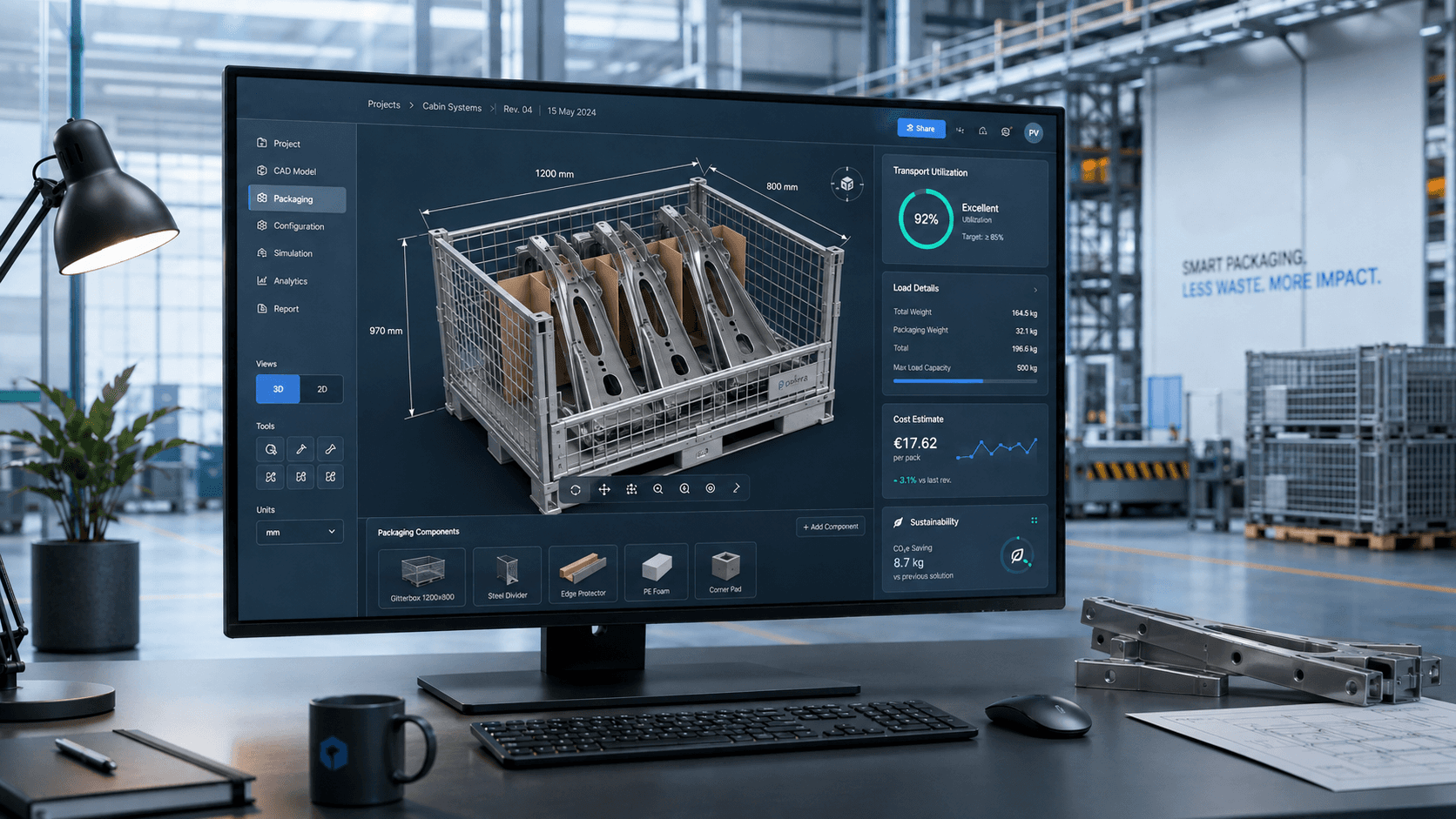
Packaging decisions are often made too late, when costly compromises are already difficult to reverse. Discover how CAD-based packaging planning helps manufacturers compare options earlier, improve container utilization, and turn fragmented decisions into a structured and traceable process. This article reveals why better packaging is not just about fitting more parts into a container, but about creating more efficient, robust, and future-ready supply chains.
At first glance, packaging seems like a minor operational detail. A component must be transported safely from point A to point B, a suitable container must be available, and clear packing instructions must be prepared. At the same time, the solution should be as cost-effective and sustainable as possible.
In practice, however, packaging decisions have a much greater impact. Packaging influences freight costs, warehouse and production space, handling, material usage, quality, workplace safety, coordination efforts, and, increasingly, regulatory requirements.
Nevertheless, in many industrial companies, packaging concepts are still planned late in the process, manually, or based on historical experience. Existing containers are reused, physical packing trials take place only shortly before the start of production (SOP), and fundamental discussions often begin at a point when changes are already costly and the scope for influence is limited.
This is precisely where CAD-based packaging planning comes in. It shifts key packaging decisions to an earlier stage of development, when the component, container, and process can still be influenced with relatively little effort.
Why Late Packaging Planning Can Become Costly During Series Production
If you wait to plan and optimize packaging until components have already been fully developed or the first prototypes are available, you lose valuable design flexibility. By that point, many fundamental decisions have already been made.
Component geometry, protection requirements, packaging hierarchy, containers, packaging materials, transport routes, warehousing logic, and process flows can often only be changed at a significantly higher cost.
The resulting inefficiencies are rarely due to a single wrong decision. Most often, they are the result of many small compromises. A container is slightly too large. A packing pattern does not make sufficient use of the available volume. The packing method is impractical in the warehouse. Automated retrieval in production is unnecessarily complex. The weight is just above a practical handling limit. The costs are significantly above the planned budget. An interlayer concept may work in theory, but proves too labor-intensive in day-to-day operations.
Each of these deviations may seem manageable when considered in isolation. However, with recurring production runs, high unit volumes, and multiple locations, their effects multiply.
CAD-based packaging planning and packaging optimization reveal these interdependencies as early as the component development phase. It shows which packaging variants are possible under defined conditions and what effects they have on capacity utilization, weight, empty space, handling, storage, and documentation.
What CAD-based packaging planning achieves for container selection and packing patterns
At its core, CAD-based packaging planning connects three levels:
the product’s geometry
the available packaging space
the operational conditions
From this information, possible component arrangements and relevant key metrics can be derived. These include, among other things, the number of parts per container, volume and weight utilization, void space, total weight, and the number of packaging units and loading units required.
It is crucial to note that the best solution is not automatically the one with the highest packing density.
A packing pattern with maximum volume utilization may nevertheless be unsuitable in practice. This is the case, for example, when sensitive surfaces are subjected to stress, necessary gripping spaces are missing, retrieving the components takes too long, the permissible container weight is exceeded, or the loading unit is not sufficiently stable during transport.
Thorough digital packaging planning therefore does not merely answer the question of how many components fit into a container.
It also answers the following questions:
What component orientations are possible?
Is the packaging solution manageable for both people and machines?
Is the design sufficiently stable for transport and storage?
Are the weight and load capacity plausible?
Are safety clearances and sensitive areas taken into account?
Does the concept align with the packing sequence and retrieval process in day-to-day operations?
Can the variant be documented, approved, and reproduced later?
Which containers are suitable for the component?
What are the volume and weight utilization rates?
Which packaging hierarchies make sense?
Is the packaging concept sustainable?
The real added value, therefore, does not lie solely in a single simulation. It lies in the systematic comparison of many different variants and packaging configurations.
Logistics, packaging planning, production, quality, procurement, and development can evaluate different solutions based on the same criteria. As a result, decisions are based less on isolated assessments and individual experience.
Why CAD Data and Container Data Determine the Quality of Packaging Planning
Digital packaging planning is only as reliable as the data on which it is based. Incomplete geometries, incorrect dimensions, or poorly maintained container data can lead to seemingly precise results that nevertheless prove unsuitable in practice.
CAD Data: What Information Is Relevant for Packaging Design
Suitable 3D data is required for digital design, for example in the STEP, STL, OBJ, or IGES formats.
It is not only the outer contours of the component that are relevant. Sensitive areas, permissible contact points, possible orientations, weight, and tolerances must also be taken into account.
In early development phases, a simplified geometric model may suffice. However, it must at least include the contours that are critical for collision detection, clearance, gripability, and protective function.
If the component weight is not yet known, it can be approximated using density and volume.
Container and packaging material data: What the simulation must model
Equally important is complete data on containers and packaging materials. This includes, among other things:
usable internal dimensions
external dimensions
net weight
load capacity
divider thickness
cost
Inserts, dividers, lids, compartments, and protective materials must not be treated as secondary considerations. They reduce the actual usable packaging space and thus affect capacity utilization, packing patterns, and handling.
Consistent measurement rules prevent erroneous packaging decisions
Consistent measurement rules are not mere formalities. When different locations, suppliers, or departments record measurements differently, planning errors and non-comparable data sets result.
The GS1 Package and Product Measurement Standard describes a consistent and repeatable process for determining product and packaging dimensions. Even if companies develop their own internal rules for industrial packaging, the fundamental principle remains crucial: Dimensions must be recorded in a uniform, traceable, and reproducible manner.
CAD-Based Packaging Planning in 6 Steps: From Simulation to Packing Instructions
A structured process helps translate digital packaging planning into reliable and operationally viable decisions.
1. Clearly define the planning scenario and framework conditions
At the outset, it must be clearly defined which component and which specific application are being considered.
This includes the shipping location, the recipient, the transport route, and the quantity. A clear definition prevents different use cases or logistical requirements from being mixed together.
2. Thoroughly document CAD data and planning assumptions
In the next step, component data, units of measurement, orientation, weight, container data, and protection requirements are reviewed and documented.
This documentation is particularly important in early development phases, as components, packaging, and processes are often not yet finalized. Planning assumptions must therefore be clearly labeled.
3. Define packaging restrictions before the packing simulation
Sensitive surfaces, prohibited orientations, excluded packing methods, minimum clearances, maximum weights, gripping spaces, and packing sequences should be defined before the simulation.
Otherwise, variants may arise that appear geometrically possible but are not operationally feasible or practical.
4. Compare packing variants, containers, and packaging hierarchies
Subsequently, different containers, packing methods, stable layers, packing directions, packing quantities, inserts, and packaging hierarchies are compared with one another.
In addition to the packing quantity per container and the utilization of volume and weight, at least the following criteria should be considered:
Total weight
Number of containers required
Number of loading units
Packaging hierarchies
Material costs
Transportation costs
Handling effort
Shelf life
This creates a well-founded basis for comparison that goes beyond mere packing density.
5. Physically validate digital results in a risk-appropriate manner
Digital packing simulations do not universally replace every physical test. For non-critical applications, the scope of manual packing trials can be reduced.
For sensitive components, potential impacts on workplace safety, or high potential costs of errors, final physical packing tests are still advisable.
However, digital packaging optimization reduces the number of variants that actually need to be tested in real-world conditions. For packaging and loading unit tests, Fraunhofer IML cites, among other things, climatic influences, vibrations, and dynamic loads as relevant test areas.
6. Document Packaging Instructions and Manage Changes
The approved packaging concept should be documented along with the component configuration, the container, the packaging materials, the packing sequence, the quantities, the views, the validity, and the responsibilities.
If the component, container, route, or process changes, it must be clearly defined whether a re-evaluation and re-approval are required.
Digital Packing Simulation and Physical Packing Tests: Why the Two Go Hand in Hand
Digital simulation and physical validation address different questions.
Digital analysis verifies whether component geometries fit together under defined rules, whether a packaging concept appears fundamentally feasible, and which variants are mathematically advantageous.
Physical testing, on the other hand, demonstrates how loading and unloading, materials, cushioning, connections, the loading unit, and the product behave under realistic stress conditions.
When properly combined, they create an efficient validation process. First, digital analysis narrows down a large number of possible solutions to a few plausible packing options. Subsequently, only the most promising variants are physically tested. The insights gained from this process can, in turn, be incorporated into future planning as new rules or threshold values.
This connection is important because high utilization alone is not sufficient proof of quality. A container may be filled perfectly according to calculations yet still cause damage, ergonomic problems, or process disruptions.
Good packaging planning therefore combines efficiency with protective effectiveness, practicality, and traceability.
PPWR and Packaging Minimization: Why Void Space and Documentation Are Becoming More Important
The EU Packaging Regulation (PPWR) has been in effect in principle since August 12, 2026. It replaces the previous Packaging Directive and establishes a more uniform European framework for packaging and packaging waste.
Of particular relevance to industrial companies is the requirement that packaging minimization must be more thoroughly documented and justified.
Article 10 of the PPWR requires that, as of January 1, 2030, packaging be designed so that its weight and volume are reduced to the minimum necessary for its function. The technical documentation must include, among other things, the specifications used, the reasons against further reduction, and relevant evidence. This may include tests, studies, modeling, or simulations.
Article 24 additionally stipulates a maximum void space ratio of 50 percent for consolidated, transport, and e-commerce packaging. This requirement takes effect on January 1, 2030, or three years after the entry into force of the relevant implementing acts, whichever is later.
Filling materials such as paper, bubble wrap, foam, or wood wool are also considered void space.
Proper classification remains crucial: CAD-based packaging design does not automatically guarantee PPWR compliance. However, it can help companies evaluate and document packaging volume, void space, technical assumptions, and decision-making criteria early on and in a traceable manner.
It is precisely this traceability that is gaining importance in an increasingly regulated packaging environment.
Packaging Optimization as a Business Process: Where the Greatest Benefits Lie
Many companies initially associate packaging optimization with a single question: How can more parts be accommodated in a single container?
This question is important, but it does not go far enough.
Greater leverage is achieved when packaging planning is understood as a repeatable business process. This requires well-maintained container data, clear responsibilities, defined approvals, traceable versioning, and a link between component revisions and packaging versions.
Only then does a good individual decision become a robust standard.
A packaging concept is not only valuable if it works today; it must also remain traceable at a later date. This applies, for example, when another location, a new supplier, a quality manager, or a customer wants to know exactly why this particular packaging was chosen.
Digital Packaging Planning with Pakera: Compare Variants and Document Decisions
Pakera supports this process by consolidating CAD-based packaging analyses, container variants, packing instructions, approvals, and documentation into a single platform. Pakera goes far beyond mere packaging optimization and takes a holistic approach to the packaging process and related areas. This is what Pakera means by next-gen packaging planning.
The software helps companies review packaging concepts early on and holistically, make different variants comparable, and document decisions in a traceable manner.
Technical responsibility deliberately remains with the relevant corporate roles. Software can visualize assumptions, calculate variants, and structure approval processes. However, it does not replace the product- and process-specific assessment carried out by logistics, packaging planning, quality, production, or procurement.
It is precisely this connection that is crucial: digital speed on the one hand and operational reality on the other.
Pakera is designed not to make packaging decisions more abstract, but to make them more tangible. Users should be able to recognize more quickly which solutions are technically feasible, economically sound, and practically implementable.
Conclusion: Early packaging planning creates more efficient and robust supply chains
CAD-based packaging planning shifts important decisions to an earlier phase. It reveals which variants are possible, which data is still missing, which restrictions are critical, and where a concept appears convincing only on paper.
For industrial companies with recurring components, serial production processes, and multiple departments involved, this can result in a significant advantage:
fewer late corrections
less ad-hoc coordination
less unnecessary empty space
better packing instructions
greater transparency regarding costs, handling, storage, and process capability
The central idea is this: Packaging is not a downstream shipping step. It is a controllable component of product, logistics, and process planning.
Those who leverage this opportunity early on not only make better decisions regarding containers and packing patterns; they also lay the foundation for more efficient, robust, and traceable supply chains.
Pakera supports companies in taking this step: moving from late-stage packing decisions to early, data-driven, and documented packaging planning.
How Pakera supports efficient packaging planning
Digital Pallet & Container Optimization
Packaging Report & Documentation
Sources:
Package and Product Measurement Standard. GS1, current version. https://www.gs1.org/standards/gs1-package-and-product-measurement-standard/current-standard
IMO/ILO/UNECE Code of Practice for Packing of Cargo Transport Units. United Nations Economic Commission for Europe, 2014. https://unece.org/transport/intermodal-transport/imoilounece-code-practice-packing-cargo-transport-units-ctu-code
Packaging Testing: Efficiency and Safety in Logistics. Fraunhofer Institute for Material Flow and Logistics IML, no date. https://www.iml.fraunhofer.de/de/abteilungen/b1/verpackungs_und_handelslogistik/labor_infrastruktur/verpackungslabor1.html
ASTM D4169-23e1: Standard Practice for Performance Testing of Shipping Containers and Systems. ASTM International, 2023. https://store.astm.org/standards/d4169
VDA 5007: Guidelines for Container Management, Version 3.0. German Association of the Automotive Industry, July 2017. https://www.vda.de/dam/jcr%3A0fc577b6-9b1e-4f97-a79e-50c04420d553/VDA-5007-DE-Leitfaden-zum-Behaeltermanagement-V3p0-2017-07.pdf
Regulation (EU) 2025/40 on Packaging and Packaging Waste. European Parliament and Council, December 19, 2024. https://eur-lex.europa.eu/eli/reg/2025/40/oj/deu