
Technology
Leading Manufacturers of Humanoid Robots in the EU: Market Overview 2026
Thomas Goldhofer
·
Co-Founder
·
·
9 min

In 2026, European manufacturers will deploy several humanoid robots in industrial pilot projects, but there remains a wide gap between technical ambition and proven operational readiness. This market overview compares the leading providers based on publicly documented field tests, technical specifications, and their suitability for logistics. An evidence-based ranking shows who is currently in the lead and which systems are particularly well-suited for which tasks.
Humanoid Robotics in 2026: Between Spectacular Demos and Real-World Logistics Operations
By 2026, humanoid robots will have reached a point where they can no longer be viewed solely as research projects. The first systems are operating in production and logistics environments, manufacturers are building up mass-production capacity, and major industrial companies are entering into long-term partnerships with robotics firms. Nevertheless, the market is still a long way from widespread industrial deployment.
A study published in March 2026 by Fraunhofer IML identified around 80 humanoid or humanoid-inspired systems with potential relevance for logistics. The market is highly fragmented and continues to be dominated primarily by non-European providers. However, about three-quarters of the companies surveyed expect to put humanoid robots into productive use within the next ten years. Fraunhofer specifically cites test beds, open standards, safe human-robot collaboration, and the increased digitization of logistics processes as prerequisites for a breakthrough.
This is precisely where, in 2026, the decisive dividing line between marketing and industrial reality still lies. Fraunhofer IPA has therefore developed a standardized humanoid benchmark designed to objectively measure, among other things, cleanroom compatibility, functional safety, cybersecurity, energy efficiency, capabilities and navigation, as well as system integration. The researchers explicitly point out that the market is currently too opaque and volatile to reliably assess actual industrial suitability based solely on manufacturer specifications.
From a logistics perspective, this is particularly relevant. An impressive walking demonstration says little about whether a robot can pick containers for eight hours, navigate around unplanned obstacles, communicate with SAP EWM or a WMS, and continue working autonomously after a grasping error.
Cost also remains a decisive factor. McKinsey roughly estimates the cost of today’s humanoid robots at $30,000 to $150,000 and assumes that achieving a true mass market could require cost reductions of more than 50 percent. Actuators can account for up to 60 percent of these costs. A recent NEXERY study projects an average price of around $55,000 for industrial humanoids by the end of the decade. At the same time, the study clearly identifies the technical maturity limit in 2026 as still being confined to structured operating environments: material handling, picking, simple assembly, and inspection are possible, while robustness, energy and thermal management, and safe human-robot interaction in unstructured environments continue to pose hurdles.
For logistics companies, this means: The most interesting question is no longer whether humanoid robots work in principle. The decisive factor is which manufacturer will be the first to turn an impressive demonstration into a reliable, integrable, and cost-effective logistics worker.
The 2026 Robot Ranking from a Logistics Perspective
For this ranking, we weight manipulation and payload at 25 percent, autonomy and perception at 20 percent, logistics and IT integration at 20 percent, maturity/safety/practical experience at 20 percent, and cost-effectiveness and scalability at 15 percent. This is intentionally an evidence-weighted editorial ranking, not a standardized laboratory test.
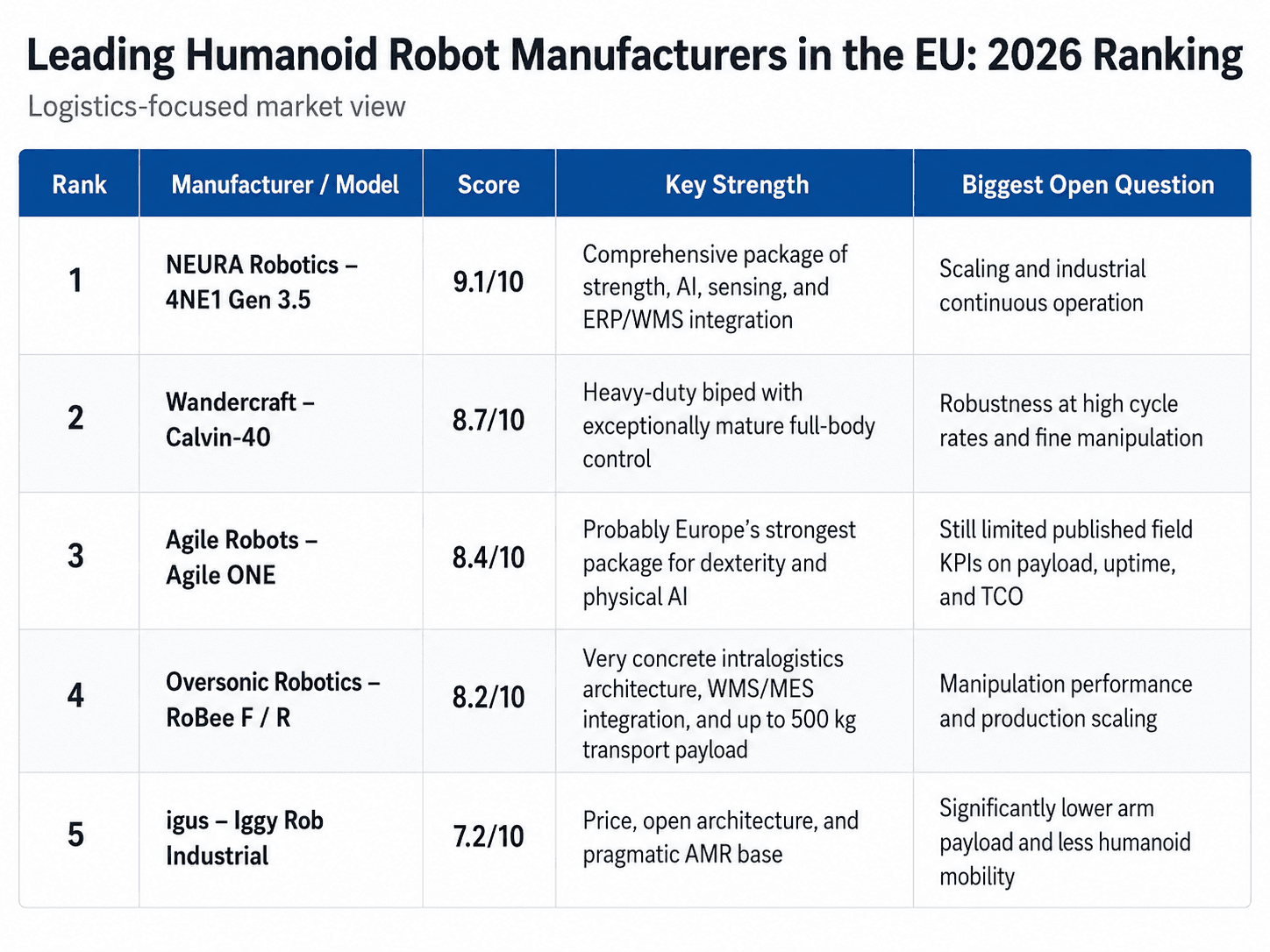
Table 1: Logistics-focused 2026 ranking of leading European humanoid robot platforms, highlighting their key strengths and the main challenges still limiting large-scale industrial deployment.
The Most Important Technical Comparison Parameters
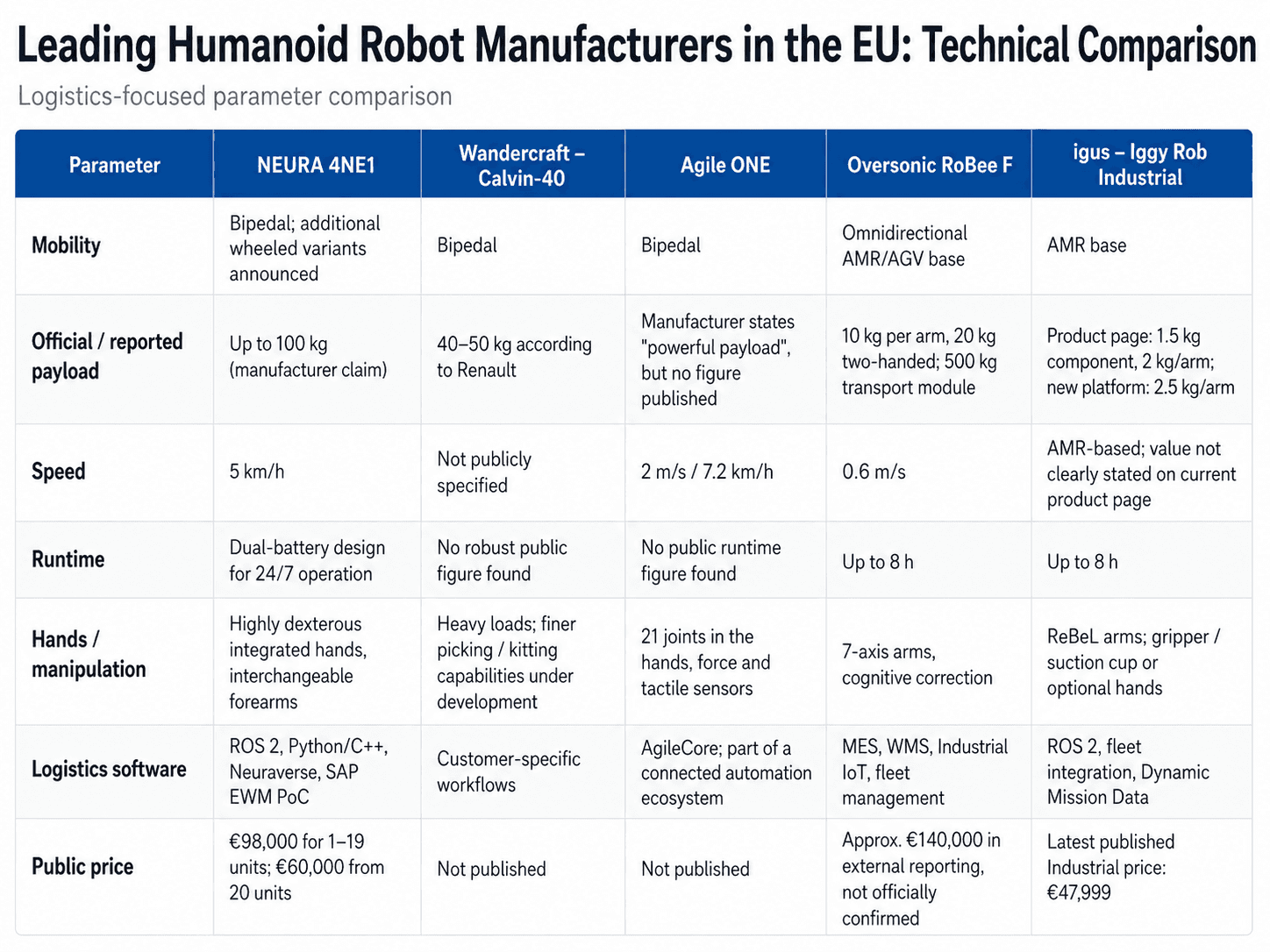
Table 2: Technical comparison of five European humanoid robot platforms across mobility, payload, speed, runtime, manipulation capabilities, logistics software integration, and publicly available pricing.
The table also highlights a fundamental problem in today’s market: “payload” is not a uniformly defined metric. NEURA states that 4NE1 can “lift” up to 100 kg. Renault reports a payload capacity of 40 to 50 kg for Calvin and demonstrates a payload of around 30 kg in the form of two tires. Oversonic, on the other hand, clearly distinguishes between 10 kg per arm, 20 kg with both arms, and a 500 kg transport load on the vehicle module. With Iggy Rob, the arm/component payload and the load capacity of the mobile platform differ significantly. As long as there is no cross-manufacturer standard test, an operator should therefore never compare only the highest kilogram figure.
1. NEURA Robotics 4NE1 Gen 3.5 – currently the most compelling European all-around package
With the 4NE1, NEURA Robotics of Metzingen is pursuing the most ambitious European approach to a universally applicable humanoid robot. The current Gen 3.5 model stands approximately 1.80 meters tall and weighs about 80 kg, according to the manufacturer. NEURA specifies a payload range of 10 to 100 kg for the 4NE1 family; when introducing the third generation, the company specifically stated that the robot’s joint technology allows it to lift up to 100 kg. Its maximum speed is listed as 5 km/h.
For a logistics provider, however, the maximum payload is not the most interesting aspect of the system. What matters most is the combination of full-body sensor technology, manipulation, perception, and software integration. NEURA highlights 360-degree perception, a sensory “skin,” multimodal AI, computer vision, and reinforcement learning. The patented OmniSensor is designed to distinguish between people and objects, enabling the robot to adapt its behavior accordingly. Added to this are fine-motor, adaptive hands and interchangeable forearms.
For Gen 3.5, NEURA has already specified very concrete technical interfaces: Wi-Fi 6, Ethernet, Python SDK, ROS 2, and C++ SDK. It also includes digital twin access, teleoperation, and integration with the NEURA Gym training system. The officially described application areas are multimodal interaction, operation or manipulation, and transport tasks.
Why 4NE1 Is Particularly Interesting for Logistics
The most interesting real-world demonstration to date comes from a joint proof of concept by NEURA, SAP, and BITZER. At a BITZER warehouse in Rottenburg, 4NE1 was connected to SAP S/4HANA Extended Warehouse Management via the SAP Business Technology Platform. The robot performed picking tasks autonomously and synchronized its work with SAP business logic. According to the project partners, it was also able to respond to last-minute changes in orders. Before physical deployment, the scenario was trained in NVIDIA Isaac Sim.
In my view, this is a key difference from many spectacular humanoid demos. For a real-world logistics operation, it is far more valuable for a robot to correctly process a modified EWM order than for it to be able to run particularly fast across a stage.
NEURA has also announced various 4NE1 models. In addition to the classic humanoid design, variants on wheels for industrial floors as well as versions with an additional seventh axis or extended range will be available. This makes sense: Where climbing stairs isn’t necessary, a wheeled base can be superior in terms of energy efficiency and cost-effectiveness.
Partnerships: SAP, BITZER, Schaeffler, and NVIDIA
The technology partnership with Schaeffler is particularly relevant. Among other things, Schaeffler is set to develop and supply key components such as actuators. At the same time, Schaeffler plans to deploy NEURA humanoids in its own global production network and integrate a mid-four-digit number of them by 2035. NEURA explicitly states that the collaboration is intended to secure the supply of actuators for continuous-duty operation, support industrialization, and simultaneously generate real-world production data for the Neuraverse.
In doing so, NEURA addresses two of the biggest challenges facing virtually every humanoid manufacturer at the same time: industrial-scale production volumes and real-world training data. The SAP/BITZER partnership complements this approach by providing enterprise and logistics software. NVIDIA Isaac Sim is already being used for the virtual preparation of real-world logistics tasks.
What is NEURA currently focusing on most?
NEURA does not publicly identify any single problem as its “biggest technical weakness.” However, based on its current partnerships, it’s relatively clear that industrialization, actuator supply, long-term durability, and the collection of high-quality real-world data are currently the main focus. This aligns with McKinsey’s industry-wide analysis, which identifies actuators and the industrial supply chain as the key scaling bottlenecks in humanoid robotics.
From a technical standpoint, NEURA must now prove that its impressive combination of a 100-kg maximum payload, complex sensor technology, and cognitive software remains economically stable even after thousands of hours of operation in real-world shift systems. As of 2026, publicly available MTBF, uptime, and cycle time data for precisely this aspect are still lacking.
How much does the 4NE1 cost?
Here, NEURA is unusually transparent by European standards. For the 4NE1 Gen 3.5, the pre-order page lists an estimated price of 98,000 euros per unit for orders of 1 to 19 units and 60,000 euros per unit for orders of 20 or more units, in each case excluding taxes and shipping. The pre-order fee is 100 euros; availability is announced for late 2026.
This is strategically noteworthy: a price of 60,000 euros for high-volume orders would already be close to the average price level that market studies expect only by the end of the decade. However, it remains to be seen whether this price will also be achievable for fully equipped industrial projects, including integration, engineering, safety concepts, service, and peripherals.
Logistics Assessment
The 4NE1 is the most technically advanced European candidate in 2026. Above all, the proven track record with SAP EWM, the high stated payload, the open software integration, and the concrete industrialization partnership with Schaeffler place NEURA in first place.
2. Wandercraft Calvin-40 – Europe’s Heavy-Duty Specialist on Two Legs
Wandercraft originally comes from a completely different field. The French company developed self-balancing exoskeletons and, as a result, has gained years of experience with dynamic full-body control, balance, and safety-critical robotics. It is precisely this expertise that is now embodied in the humanoid Calvin-40. According to Wandercraft, the platform is based on more than a decade of exoskeleton development.
Calvin has been specifically designed for physically demanding industrial tasks. Wandercraft highlights high-torque motors, a high-strength structure, and full-body control that automatically adapts to the current load. 3D sensors and AI-based image processing are used for perception. Autonomous navigation is planned. A certifiable safety system is intended to enable operation without physical safety barriers. Wandercraft also cites a failure rate of less than 1 in 1,000 as a development goal.
Wandercraft does not currently publish a publicly accessible, complete data sheet table listing its own weight, battery capacity, or range. However, Renault provides a figure that is significantly more valuable for practical applications: At the Douai plant, Calvin lifts two tires weighing a combined total of approximately 30 kg during test operations. Renault states that Calvin can carry 40 to 50 kg. For stabilization, it uses, among other things, IMUs in its limbs, force sensors under its feet, and an RGB-D camera.
Skills Already Demonstrated
On its product page, Wandercraft lists four key application categories: handling of large to precision components, material flow involving cartons, crates, and packages, picking and kitting, as well as production tasks such as assembly and machine operation. The manufacturer’s wording is important: Calvin has already learned and executed recurring industrial workflows. More precise handling tasks, such as picking and kitting small and large objects, are currently being further developed.
For logistics, this is a very significant distinction. Heavy material handling is already a core competency. Fine-grained order picking is still a work in progress. Calvin is therefore particularly well-suited today for containers, tires, crates, large parts, and material staging—and less so for the rapid handling of many small, heterogeneous items.
Renault as a Development Partner and Future Major User
In 2025, Renault acquired a stake in Wandercraft and simultaneously entered into a commercial partnership to develop an entire family of new robots. Renault is contributing not only capital but also production expertise, concrete use cases, and design-to-cost experience. Later, the collaboration is also set to encompass the industrialization of robots and exoskeletons to reduce costs through economies of scale and automotive production methods.
The partnership has now moved far beyond a traditional demo setup. Renault is projecting approximately ten robots by the end of 2026 and a roadmap of 350 units in French and Spanish plants by the end of 2027. Calvin is already being tested in a real-world tire-handling process at the Douai plant.
In addition, Wandercraft has entered into a deployment partnership with the Italian automotive supplier SAPA. There, the initial focus will be on implementing high-precision, repetitive movements of large and heavy parts, followed by the joint development of real-world use cases for high-throughput production environments.
The biggest problem right now? Renault puts it unusually bluntly
At Wandercraft, this question can be answered much more concretely than at most competitors. Renault explicitly cites two key challenges: robustness and integration into a high-cycle-speed production environment. At the same time, more dexterous hands are expected to enable finer work in the future.
This is precisely the point at which humanoid development is currently being decided. Successfully moving a box ten times is a demonstration. Running a process tens of thousands of times with availability close to that of traditional industrial automation is a production system.
Price and Cost-Effectiveness
Wandercraft and Renault have not yet published an official unit price for Calvin-40. Wandercraft claims on its product page that recurring workflows could become up to three times more cost-effective with Calvin. However, without published assumptions regarding purchase price, service life, maintenance, and utilization, this manufacturer’s claim cannot yet be independently evaluated. The first series delivery is announced for the first half of 2027.
The partnership with Renault also suggests that cost reduction remains an active area of development: “design-to-cost” and scaled production are explicitly cited as goals of the collaboration.
Logistics Assessment
Anyone who needs to move heavy containers or larger components in a human-built environment—and actually needs legs to do so—should keep a very close eye on Calvin.
3. Agile Robots Agile ONE – Perhaps the Most Capable European Humanoid
Agile Robots, based in Munich, takes a slightly different approach. The company has its roots in industrial robotics, automation, and AI, giving it a broad existing ecosystem of robotic arms, mobile robots, software, and system integration. Agile ONE is not intended to function as an isolated humanoid, but rather as an integral part of this networked automation system.
Technically, the hand stands out in particular. Agile Robots specifies 21 joints, modular fingers, and integrated force and tactile sensors. The robot also features cameras, LiDAR, speech recognition, proximity sensors, a chest-mounted display, and visual status indicators. Its walking speed is officially listed at 2 m/s or 7.2 km/h, which is significantly higher than the speed published for NEURA.
Interestingly, Agile Robots has not yet published a specific payload capacity in kilograms. The product page merely refers to a “powerful payload.” This represents a significant information gap for technical procurement comparisons. Especially in logistics, therefore, one should not derive an assumed payload from videos or the performance capabilities of individual Agile Robots arms.
What skills does Agile Robots officially list?
Agile Robots already describes an exceptionally broad range of applications: material handling, pick-and-place, machine operation, tool use, and precise manipulation tasks. Agile ONE is designed to navigate autonomously between workstations, collaborate with humans, and perform complex tasks via a Robot Foundation Model.
This model combines real production data, simulation data, teleoperation data, and motion data recorded by humans. The architecture is intended to integrate strategic task planning, rapid response, and fine-motor control across various levels.
For logistics, the combination of a highly advanced hand and a mobile full-body platform is particularly exciting. Many of today’s automation systems do not fail because they cannot move a container from A to B—AMRs are already very good at that—but because they cannot flexibly identify and safely grasp different parts inside that container. This is precisely where Agile ONE could have its greatest strength in the long term.
Partnerships: Google DeepMind, Telekom/NVIDIA, and a Growing Integration Network
In March 2026, Agile Robots announced a strategic research partnership with Google DeepMind. The plan is to combine Gemini Robotics Foundation Models with Agile’s hardware. Both companies aim to deploy real-world systems, collect data, further train the models, and continuously repeat this cycle. The focus is explicitly on industrial applications where reliability and scalability are critical.
In addition, Agile Robots uses the Industrial AI Cloud from Deutsche Telekom and NVIDIA. According to the company, this infrastructure is based on 10,000 NVIDIA GPUs and is used for training and generating simulation data.
At the same time, Agile Robots is massively building up its integration expertise. In 2026, assets from thyssenkrupp Automation Engineering were acquired and continued under the name Krause Automation. This provides Agile with decades of plant engineering and integration expertise. In August 2026, the company acquired a majority stake in the Indian factory and intralogistics specialist XNG Automation. Among other things, XNG has experience in system integration, image processing, and high-throughput automation.
What is the biggest challenge right now?
Agile Robots does not publicly identify any single, central weakness. However, current developments reveal a clear focus: Turning highly capable AI and manipulation into a reproducible industrial solution that can be reliably and cost-effectively integrated into real-world factories.
This assessment is supported by external reporting. The Wall Street Journal reported in early August 2026 that while Agile Robots already has a very large traditional robotics business, its humanoid systems are still limited to pilot projects. This does not mean that Agile ONE is technically weak—on the contrary. It means that, so far, there is less publicly available data on real-world continuous operations, uptime, cycle times, and maintenance requirements than, for example, concrete process data from the Renault/Wandercraft or SAP/NEURA collaborations.
The DeepMind partnership also highlights the areas where intensive work is underway: better generalization, adaptive reasoning, and a data cycle involving deployment, data collection, training, and redeployment.
Price
On the manufacturer’s websites and in the latest press releases I reviewed, there is still no publicly available purchase price or RaaS rate for Agile ONE. A reliable TCO figure has not been published either. According to the announcement, series production is scheduled to begin in early 2026 at a new production facility in Bavaria.
Logistics Assessment
When it comes to grasping, tactile sensing, and integrating robot hardware with modern foundation models, Agile ONE is one of the most technically exciting candidates in Europe. What’s currently missing for it to take first place is, above all, more transparent data on payload, runtime, price, and long-term performance from real-world logistics installations.
4. Oversonic Robotics RoBee F – the humanoid designed with logistics in mind from the very beginning
It’s worth taking a closer look at the Italian manufacturer Oversonic. The RoBee family includes various versions. For this comparison, the RoBee F is particularly interesting because this model was specifically developed for intralogistics. Unlike traditional bipedal humanoids, the RoBee F stands on an omnidirectional AMR/AGV platform and combines a humanoid upper body with a rear transport module.
From a logistics perspective, this is extremely pragmatic. A warehouse floor generally does not require climbing stairs. Wheels are energy-efficient, stable, and have been tried and tested in industrial settings for years. Oversonic can therefore move significantly more payload than can be handled by its arms.
According to the manufacturer, RoBee F is approximately 2.00 meters tall and weighs 850 kg. The two seven-axis arms have a reach of 120 cm. The payload is 10 kg with one arm or 20 kg with both arms. The rear transport module, on the other hand, can carry up to 500 kg. The maximum speed is 0.6 m/s. Oversonic cites a typical battery life of up to eight hours. Obstacle detection is handled by a SIL-3 system; eight cameras, LiDAR, and depth cameras supplement the perception capabilities.
For manipulation tasks, Oversonic publishes unusually specific accuracy values: ±0.5 mm repeatability, ±1 mm deterministic accuracy, and ±5 mm “cognitive” accuracy. However, these values are manufacturer specifications and not the result of a cross-manufacturer benchmark.
Existing Logistics Capabilities
According to the manufacturer, RoBee F can autonomously plan routes, transport pallets and industrial containers, perform pick-and-place tasks, and navigate dynamically in shared environments. The vertical pneumatic design with axial rotation expands the working range for shelves, containers, and varying working heights.
The IT aspect is particularly relevant: Oversonic explicitly describes compatibility with MES, WMS, and Industrial IoT platforms, centralized fleet management, real-time monitoring, and material flow optimization. Thus, from the outset, RoBee F addresses precisely the level of integration that often requires more effort in real-world logistics projects than the robot itself.
The broader RoBee platform also offers AI-based object recognition, cognitive and adaptive pick-and-place functions, data collection and analysis, as well as collaboration with automated warehouse systems.
Partnerships and Real-World Deployments
Of particular interest is the collaboration with STMicroelectronics. At the end of 2025, a supply agreement was announced for the introduction of customized RoBee systems into the production and logistics processes at several ST sites. The first robot was deployed at ST’s advanced packaging and test facility in Malta, with an initial fleet set to follow.
Oversonic is also working with SEW-EURODRIVE on smart factory, logistics, and collaborative automation scenarios, including pick-and-place and environmental monitoring. A research project is underway with the University of Genoa to develop novel robotic hands made of flexible materials.
In June 2026, STMicroelectronics, Fondazione ENEA Tech Biomedical, and SpotInvest also invested in Oversonic. The capital and industry partnerships are explicitly intended to accelerate industrial, technological, and international expansion, as well as the expansion of production capacities and applications.
What is Oversonic currently working on?
Oversonic does not identify a single “biggest weak point.” However, its public development programs highlight two very clear areas for improvement: scaling industrial capacity and further developing manipulation capabilities, specifically the robotic hands. The collaboration with the University of Genoa on the next generation of hands is a concrete example of this. At the same time, the platform and production capacity are set to grow alongside the new industrial investors.
From a logistical perspective, the current architecture is already robust for heavy-duty transport, while the active manipulation load for both hands—at 20 kg—is significantly below that of NEURA and the Calvin level described by Renault. However, this is partly a deliberate system design choice: the vehicle carries heavy loads, while the arms handle manipulation.
Price
Oversonic does not publish an official list price for RoBee F on the product pages I reviewed. An Italian technology portal reported in 2025 a price of approximately 140,000 euros per RoBee unit. This figure should be understood explicitly as an external market estimate and not as a current official offer. Furthermore, it is unclear whether this figure applies to the current F configuration, including the 500-kg transport module.
Logistics Assessment
For those who do not equate “humanoid” with “must have two legs,” RoBee F represents an exceptionally logical logistics concept. In the areas of material handling, WMS/MES integration, and combined transport/manipulation architecture, Oversonic ranks among the most exciting European providers.
5. igus Iggy Rob Industrial – the Low-Cost Approach for Real-World Factories
Iggy Rob from igus is probably the most unconventional contender in this comparison. Like Oversonic, igus has deliberately opted not to include legs and instead relies on a proven mobile robot base. The company explains this decision with remarkable pragmatism: For many real-world industrial applications, walking legs are currently neither necessary nor cost-effective.
The current Iggy platform is based on ReBeLMove Pro. For the platform introduced in 2026, igus specifies a payload capacity of up to 250 kg for the mobile base, a height ranging from 1.30 to 1.70 m depending on the configuration, 16 degrees of freedom, and up to eight hours of autonomous runtime. By default, two ReBeL robot arms, each with a 2.5 kg payload, are used; alternatively, other cobots or humanoid hands can be integrated. Navigation is handled via LiDAR and 3D cameras.
However, there is a discrepancy in the official specifications. The Iggy Rob product page, which is still accessible, lists a robot weight of 101 kg, a maximum component weight of 1.5 kg, two arms each with a 2 kg payload capacity, and a load capacity of 50 kg or a payload of 100 kg for the older ReBeLMove Pro configuration. In contrast, the more recent press release from June 2026 specifies 2.5 kg per arm and up to 250 kg for the platform.
What tasks can Iggy Rob perform?
igus lists the transport of goods, machine loading, and simple assembly as tasks for Iggy Rob Industrial. The platform can be integrated via ROS 2, and end-effectors and sensors are interchangeable. It also features a fleet management interface and CE certification.
This approach is particularly interesting for small and medium-sized logistics and manufacturing companies. Iggy does not need to replicate the full range of human motor skills. A large portion of today’s manual material-handling tasks consists of driving, positioning containers, retrieving lightweight components, loading machines, or performing simple handoff processes. For these tasks, an affordable, open, and relatively easy-to-integrate platform may be more economically attractive than a significantly more complex bipedal robot.
The Dynamic Mission Data Interface is designed to launch missions over the network and exchange data bidirectionally in real time. This allows external AI systems to be integrated within a mission.
Partnerships and Ecosystem
Unlike with NEURA, Wandercraft, or Oversonic, the publicly available documents do not mention any similarly concrete, Iggy-specific partnerships with major customers in which hundreds of robots have already been announced or specific production processes have been publicly identified.
Instead, igus relies on an open ecosystem. Mechanics, electronics, and software are developed by igus in Cologne in collaboration with Commonplace Robotics by igus in Osnabrück. Through the RBTX marketplace, the company also offers a broad robotics ecosystem. According to igus, this ecosystem included around 100 humanoid models from 35 providers at the 2026 Hannover Messe. For customers, igus also offers “Test before you invest,” integration support, and various usage and financing models.
The biggest problem: Cost - and igus says so itself
igus puts the key market barrier in very direct terms: The use of humanoid robots in practical industrial applications currently fails primarily due to cost. The company’s response, therefore, is not to build the most technically complex robot, but rather to deliberately combine components from low-cost automation and proven AMR technology.
Technically, igus achieves this advantage at the cost of reduced handling capacity. A capacity of 2 to 2.5 kg per arm is sufficient for many small parts and simple machine loading tasks, but it is not comparable to the 40–50 kg of Calvin or NEURA’s maximum capacity of 100 kg. This is precisely where the most important technical advancement is likely to lie: greater dexterity and payload capacity without abandoning the low-cost principle.
Price
At its market launch in 2025, igus quoted a purchase price of 47,999 euros for the Iggy Rob Industrial. This made the robot one of the few European humanoids with an actually published purchase price.
Because the platform underwent technical enhancements in 2026 and igus now offers various models and configurations, the figure of 47,999 euros should be understood today as the most recently published entry-level price for the Industrial version, not as a binding price for every current configuration. The Home model introduced in 2026, for example, starts at 55,000 euros.
Logistics Assessment
Iggy Rob is not the most technically capable humanoid in this comparison. However, it could be one of the most economically sensible entry-level options if the goal is to automate light handling, intra-facility transport, and simple machine operation.
How much will a humanoid robot really cost in 2026?
The hardware alone is only part of the equation. A cost-effective logistics project also includes integration with WMS/ERP and fleet management, a safety concept, process engineering, training, end-effectors, charging infrastructure, maintenance, spare parts, and, if necessary, remote human support.
Nevertheless, we can now get a sense of the price range for the first time. NEURA officially quotes 98,000 euros, or 60,000 euros for orders of more than 20 units. igus has published a price of 47,999 euros for the Iggy Rob Industrial. For RoBee, external reports cite a price of around 140,000 euros, while Wandercraft and Agile Robots have not yet disclosed any public unit prices.
This means that European systems generally fall within the current market range described by McKinsey—approximately $30,000 to $150,000—even though special equipment and integration costs can lead to significantly higher project costs.
For a logistics manager, therefore, the decisive metric is not the purchase price per robot, but rather the price per productive work hour or per error-free process cycle. A 60,000-euro robot with low uptime can be more expensive than a 150,000-euro system that operates reliably across three shifts.
Conclusion: Who will be the most technologically advanced in 2026?
In the overall standings, NEURA Robotics is currently narrowly in the lead with its 4NE1. The combination of a high rated payload, cognitive sensor technology, highly dexterous hands, open software integration, a concrete SAP EWM pilot project, and an exceptionally strong industrialization partnership with Schaeffler is currently hard to beat in Europe.
Wandercraft may actually be even further ahead when it comes to heavy bipedal work. The field test at Renault involving real-world tire handling and the open acknowledgment of remaining challenges—robustness, high-speed integration, and more dexterous hands—make Calvin-40 particularly credible.
Agile ONE likely has the greatest potential in fine manipulation and Physical AI. Twenty-one joints in the hand, tactile sensors, real-world industrial data, and the partnership with Google DeepMind make for a technically very strong combination. However, published data on the humanoid’s payload, runtime, and continuous operation are still needed for an even higher ranking.
Oversonic has built what is perhaps the most pragmatic logistics robot. Transporting 500 kg, manipulating 20 kg with both hands, and simultaneously supporting WMS, MES, and fleet management is more relevant to many real-world material flow processes than climbing stairs.
igus, on the other hand, demonstrates what an alternative approach might look like: Less spectacular mechanics, but a deliberately affordable, modular, and AMR-based system. If humanoid robotics does indeed find its way into small and medium-sized businesses in large numbers, this very low-cost approach could become strategically more important than its fifth-place ranking might initially suggest.
The most important development over the next two years is therefore unlikely to be which robot demonstrates the most impressive new skill. What will be decisive is which manufacturer can be the first to prove that hundreds of humanoid robots can operate across multiple shifts with a level of availability, safety, and TCO that a logistics manager would accept from traditional automation.
How Pakera can help companies to get ready for a future of digital packaging planning
Packaging Report & Documentation
Digital Pallet & Container Optimization
Sources:
Fraunhofer IML — LogiMAT 2026: Fraunhofer IML Publishes Study on Humanoid Robots in Logistics (Research / Primary Source) https://www.iml.fraunhofer.de/de/presse_medien/pressemitteilungen/studie-humanoide-roboter-logistik.html
Fraunhofer IML — Humanoid Robotics in Logistics – Industry Survey, Market Study, Recommendations for Action (Study / Primary Source) https://www.iml.fraunhofer.de/content/dam/iml/en/documents/studies/Humanoid-robotics-Fraunhofer-IML.pdf
Fraunhofer IPA — Fraunhofer IPA develops standardized analyses for application-relevant criteria of humanoid robots (Research / Primary Source) https://www.ipa.fraunhofer.de/en/press-media/press_releases/benchmark-for-humanoid-robots.html
McKinsey & Company — Humanoid robots: Crossing the chasm from concept to commercial reality (Market Study) https://www.mckinsey.com/industries/industrials/our-insights/humanoid-robots-crossing-the-chasm-from-concept-to-commercial-reality
McKinsey & Company — Turning humanoid supply-chain constraints into billion-dollar wins (Market Study) https://www.mckinsey.com/industries/industrials/our-insights/turning-humanoid-supply-chain-constraints-into-billion-dollar-wins
NEXERY — 2026 Humanoid Robotics Study – Key Findings (Market Study) https://www.nexery.de/en/insights/humanoide-roboter-studie-2026
NEURA Robotics — 4NE1 – Your Next-Generation Humanoid Teammate (Manufacturer / Primary Source) https://neura-robotics.com/de/produkte/4ne1/
NEURA Robotics — Pre-order 4NE1 Gen 3.5 – Features and Pricing (Manufacturer / Primary Source) https://neura-robotics.com/de/produkt/4ne1-reservierung/
SAP — BITZER Helps SAP Pioneer Project Embodied AI (Customer/Partner / Primary Source) https://news.sap.com/2026/01/bitzer-sap-pioneer-project-embodied-ai/
NEURA Robotics / Schaeffler — Technology Partnership for Humanoid Industrial Robotics (Manufacturer/Partner / Primary Source) https://neura-robotics.com/de/starten-statt-warten-schaeffler-und-neura-robotics-starken-mit-technologiepartnerschaft-den-wirtschaftsstandort-deutschland/
NEURA Robotics — Series C funding of up to $1.4 billion – scaling production and Physical AI (Manufacturer / Primary Source) https://neura-robotics.com/de/rekord-series-c/
Wandercraft — Calvin-40 – Product and Application Information (Manufacturer / Primary Source) https://de.wandercraft.eu/calvin-40
Renault Group — Calvin: A New-Generation Robot Is Born (Industrial Customer / Primary Source) https://www.renaultgroup.com/en/magazine/technology/calvin-a-new-generation-robot-is-born/
Renault Group — Strategic partnership with Wandercraft (Industrial Customer/Partner / Primary Source) https://media.renaultgroup.com/renault-group-finalises-a-strategic-partnership-with-wandercraft-a-leader-in-next-generation-robotics/?lang=eng
Wandercraft — Wandercraft and SAPA announce deployment partnership (Manufacturer / Primary Source) https://www.wandercraft.eu/articles/wandercraft-and-sapa-announce-deployment-partnership-in-industrial-manufacturing-cementing-europes-emerging-championship-in-the-humanoids-race
Agile Robots — Agile ONE – The next evolution in Physical AI (Manufacturer / Primary Source) https://www.agile-robots.com/en/solutions/agile-one/
Agile Robots — Agile Robots to Begin Producing Agile ONE in Germany Starting in 2026 (Manufacturer / Primary Source) https://www.agile-robots.com/de/news/detail/agile-robots-produziert-industriellen-humanoiden-roboter-agile-one-ab-2026-in-deutschland/
Agile Robots / Google DeepMind — Strategic research partnership for AI robotics (Manufacturer/Partner / Primary Source) https://www.agile-robots.com/de/news/detail/agile-robots-and-google-deepmind-partner-to-bring-intelligence-to-robotics/
Agile Robots / Deutsche Telekom / NVIDIA — Industrial AI Cloud – Agile Robots as an Anchor Customer (Manufacturer/Partner / Primary Source) https://www.agile-robots.com/de/news/detail/agile-robots-wird-ankerkunde-von-europas-erster-industrial-ai-cloud/
Agile Robots — Acquisition of thyssenkrupp Automation Engineering Completed (Manufacturer / Primary Source) https://www.agile-robots.com/de/news/detail/agile-robots-schliesst-uebernahme-von-thyssenkrupp-automation-engineering-ab/
Agile Robots — Acquisition of BMW spin-off idealworks (Manufacturer / Primary Source) https://www.agile-robots.com/de/news/detail/agile-robots-uebernimmt-bmw-group-spin-off-idealworks-vollstaendig/
Oversonic Robotics — RoBee F – Humanoid Robot for Intralogistics and Cognitive Automation (Manufacturer / Primary Source) https://www.oversonicrobotics.com/robee-f/
Oversonic Robotics — Intralogistics – RoBee F and WMS/MES integration (Manufacturer / Primary Source) https://www.oversonicrobotics.com/intralogistics/
Oversonic Robotics — Supply Agreement with STMicroelectronics (Company Announcement / Primary Source) https://www.prnewswire.co.uk/news-releases/oversonic-robotics-signs-humanoid-robots-supply-agreement-with-stmicroelectronics-302647595.html
Oversonic Robotics — Research & Development – Strategic Partnerships (Manufacturer / Primary Source) https://www.oversonicrobotics.com/research-development/
Oversonic Robotics — STMicroelectronics, Fondazione ENEA Tech Biomedical, and SpotInvest acquire a stake (Company Announcement / Primary Source) https://www.prnewswire.com/news-releases/oversonic-robotics-stmicroelectronics-fondazione-enea-tech-biomedical-and-spotinvest-acquire-a-stake-in-the-company-302806639.html
Corriere della Sera – Turin — RoBee: reported unit price of approximately 140,000 euros (Secondary source – price information) https://torino.corriere.it/notizie/economia/25_luglio_17/torino-apre-la-prima-fabbrica-di-umanoidi-sono-i-nuovi-operai -1-85-centimetri-per-120-kg-di-stazza-df890c99-108f-46c4-82e2-e7825ba1axlk.shtml
igus — iggyRob – Product Information (Manufacturer / Primary Source) https://www.igus.eu/product/0-LCA-IROB?artnr=0-LCA-IROB
igus — Humanoid robotics from Germany: igus launches new service robot (Manufacturer / Primary Source) https://press.igus.eu/humanoid-robotics-from-germany-igus-launches-new-service-robot/
igus — For less than €50,000: igus presents the humanoid robot Iggy Rob (Manufacturer / Primary Source) https://press.igus.eu/for-less-than-e50000-igus-presents-humanoid-robot-iggy-rob/
igus — ReBeLMove Pro: modular robot platform for logistics, assembly, and handling (Manufacturer / Primary Source) https://press.igus.com/2025/11/26/rebelmove-pro-modular-robot-platform-for-logistics-assembly-and-handling/
igus — Hannover Messe 2026: RBTX / Humanoid Robotics in the Supplier Ecosystem (Manufacturer / Primary Source) https://press.igus.eu/igus-sets-the-course-for-worldwide-growth-and-fast-delivery-times-with-investments-in-automation-and-local-production/
SEW-EURODRIVE / Oversonic — RoBee enters the Smart Factory – joint testing (Partner / Primary Source) https://media.sew-eurodrive.com/sew_it/media/sew-eurodrive/italy/comunicati-stampa/2024-1/robee/24-10-sew-oversonic-robee-def.pdf