
Sustainability & PPWR
PPWR effective August 12, 2026: What Industrial Companies Need to Do Now
Thomas Goldhofer
·
Co-Founder
·
·
6 min

As of August 12, 2026, the PPWR generally applies directly within the EU, but not every requirement is already in effect today. This article distinguishes between immediate obligations and future design, labeling, and reusable packaging requirements, and translates them into an actionable work plan for industrial companies.
PPWR effective August 12, 2026: What industrial companies need to do now
The EU Packaging Regulation (EU) 2025/40, or PPWR for short, has been generally applicable since August 12, 2026. For industrial companies, however, this does not mean that all quotas and labels scheduled for 2030 or later have been brought forward. What matters most now is a robust clarification of roles, evidence of compliance with applicable material and packaging requirements, traceability, clear responsibilities, and the adaptation to extended producer responsibility. The binding obligations arise from the Regulation and the German Packaging Act Implementation Act. The Commission’s guidelines and FAQs are important interpretive aids but do not constitute legal norms. This article therefore provides guidance and does not constitute legal advice.
What actually applies as of August 12, 2026
The PPWR covers all packaging regardless of material and origin, including industrial sales, collection, transport, and reusable packaging. Manufacturers may only place packaging on the market that complies with the requirements of Articles 5 through 12 that are already applicable. Importers and distributors have their own obligations regarding verification, information, and corrective action. The key term here is “applicable”: Many substantive requirements have later effective dates or depend on delegated or implementing acts.
In practice, this means that companies do not need to rush to completely overhaul all their packaging to meet detailed criteria that have not yet been published. Although Article 6, paragraph 1, has required packaging to be recyclable in principle since the effective date, However, according to the Commission’s guidance, the existing requirements of the Packaging Directive and, for example, the harmonized standard EN 13430:2004 remain applicable until the new “Design for Recycling” criteria take effect. Companies currently need a documented justification specifying which requirements apply to each type of packaging, which will take effect later, and what evidence supports the chosen classification.
Shipping Labels: The New FAQ Clarifies an Important Borderline Case
The European Commission’s updated FAQ contains a practical clarification regarding transport packaging. If standard, unprinted packaging is simply folded, filled, supplemented with packing material, sealed, and affixed with a shipping, address, or SSCC label, the logistics label does not alter or brand the packaging in a way that, by itself, makes the user the manufacturer of the transport packaging. For a typical unprinted standard solution, the manufacturer’s obligations therefore generally rest with the manufacturers of the individual packaging types, such as cardboard boxes, pallets, strapping, or film.
This is a welcome relief, but not a free pass. A product or brand label, printed adhesive tape, a customer-specific design, or a technical modification can lead to a different classification. According to Article 21, an importer or distributor is treated as a manufacturer, in particular, if they place packaging on the market under their own name or brand, or modify packaging that has already been placed on the market in a way that may affect its conformity. Mere shipping routing is distinct from branding or repackaging.
Important: The FAQ statement concerns the role of the manufacturer and thus primarily conformity assessment, technical documentation, and the EU Declaration of Conformity. Whether a company is also a “producer” within the meaning of extended producer responsibility must be assessed separately for each piece of packaging, distribution channel, and Member State.
Manufacturer or Producer? Two Roles, Two Assessments
The PPWR uses “manufacturer” for product conformity of packaging and “producer” for extended producer responsibility. For sales and collective packaging, the filler or brand owner is typically the manufacturer because they are responsible for the final processing steps and filling. In the case of transport packaging, however, the actual packaging manufacturer is generally responsible, unless the user clearly marks the packaging with their name or brand. In any supply chain, there should be only one manufacturer for a given type of packaging.
For EPR, on the other hand, the determining factor is who first makes packaging or packaged products available within the territory of a Member State. A company can therefore act as a manufacturer, producer, importer, or distributor in one transaction and assume a different role in another. A blanket classification of companies is insufficient. What is required is a matrix comprising packaging type, brand, supply chain, destination country, and recipient status.
7 Concrete Implementation Steps for Industrial Companies
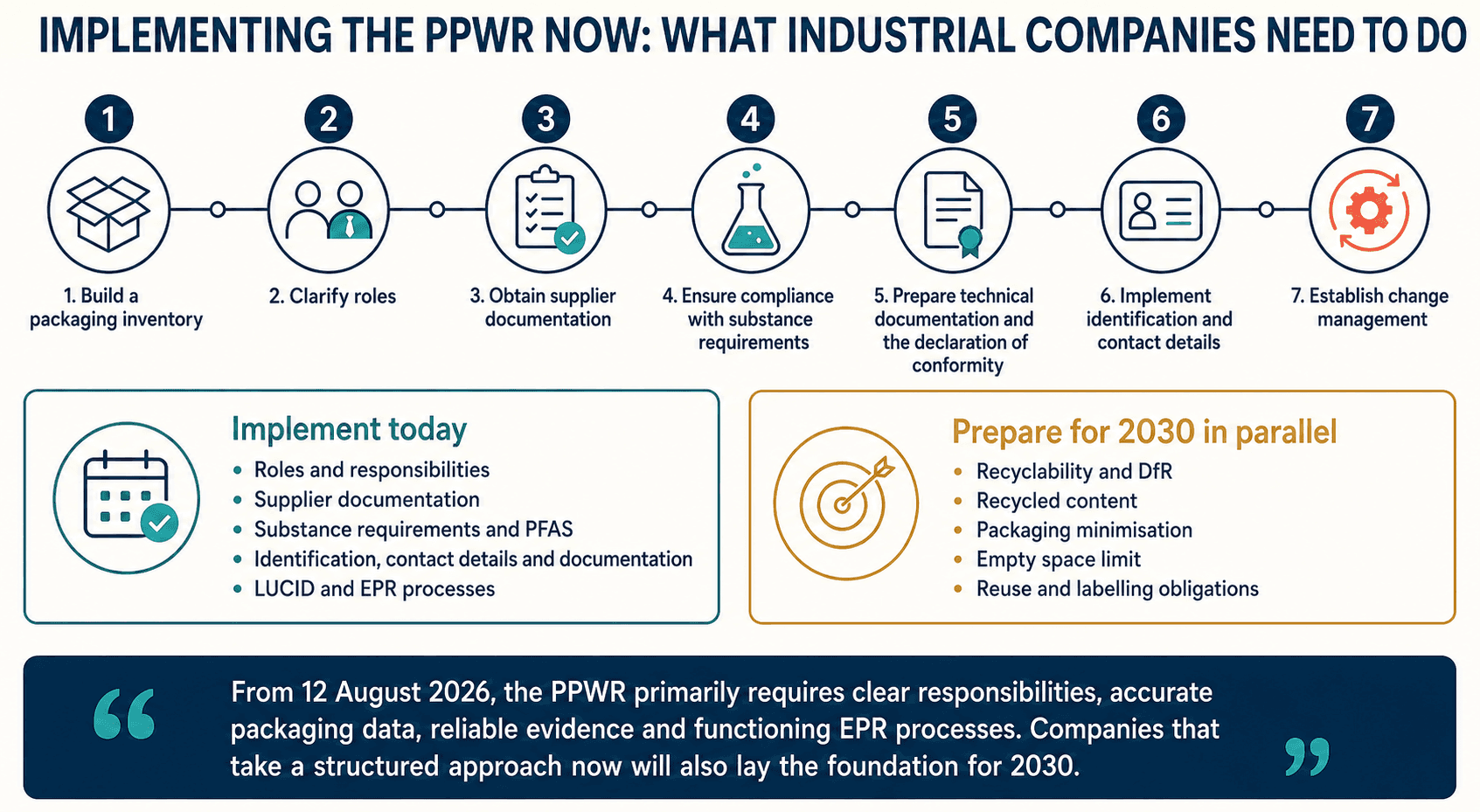
Figure 1: PPWR roadmap for industrial companies: Current obligations effective August 2026 and preparation for requirements effective 2030.
Establish a packaging registry instead of isolated Excel spreadsheets. For each packaging type, record the sales, collection, transport, e-commerce, service, or reusable status; material and weights; supplier; item number; product reference; destination countries; food contact status; brand; recycling route; and revision status. Cardboard, labels, adhesive tape, film, edge protectors, and pallets do not automatically constitute a single unit of packaging.
Define roles for each process. Document the manufacturer, supplier, importer, distributor, producer, fulfillment service provider, and end user. Also specify who prepares the EU Declaration of Conformity and who reports EPR quantities. Document borderline cases, including the rationale and approval.
Obtain supplier documentation. Article 16 requires suppliers to provide the information necessary for proof of compliance. Request material composition, substance declarations, test reports, existing certification of compliance with standards, information on reusability, and clear version and batch references. For food-contact packaging, PFAS documentation is particularly urgent.
Ensure compliance with substance requirements. The total of lead, cadmium, mercury, and hexavalent chromium must not exceed 100 mg/kg. For food contact packaging, the PPWR PFAS limits have also applied since August 12, 2026: 25 ppb for individual specifically analyzed PFAS, 250 ppb for the total of specifically analyzed PFAS, and 50 ppm including polymeric PFAS, in each case according to the statutory measurement definitions. In the absence of a fully harmonized testing method, the Commission’s guidance recommends a tiered approach involving total fluorine, organic fluorine, and further analysis.
Structure the technical documentation and declaration of conformity. Annex VII requires, among other things, a description and intended use, design and materials, applicable standards or specifications, assessment methods, and test reports. The EU Declaration of Conformity is issued for each packaging type. Documentation must be retained for five years for single-use packaging and for ten years for reusable packaging. Authorities may require that the documentation be made available within ten days.
Implement identification and contact information. Manufacturers must provide a type, lot, or serial number - or another identifying element - and must specify the name, brand, or company name, as well as the mailing address. Permissible alternatives via data media or accompanying documents depend on the size and type of packaging. Importer details may also be required. Check existing item, batch, and document numbers to ensure they can be uniquely linked, rather than creating new numbering systems in parallel.
Establish a change control process. Define which changes trigger a re-evaluation: change of supplier, material formulation, coating, adhesive, printing ink, geometry, fill level, closure, or reuse concept. A shipping label alone can be documented as a logistical process. A brand label or a material-related label change, on the other hand, belongs in the packaging version and the conformity assessment.
Germany: Reconcile LUCID and system participation now
The Packaging Act Implementation Act adjusted the national framework effective August 12, 2026. Financial responsibility may shift, particularly for private-label products and imports. Affected companies should verify brands, packaging types, material quantities, and forecasts in LUCID, adjust system participation agreements, and ensure that reports between the system operator and the registry are consistent. For industrial and transport packaging not subject to mandatory system participation, take-back, reuse, or recycling obligations remain relevant. Foreign companies without a branch in Germany must comply with the current rules on authorized representatives—however, this regulation could soon change, as the European Commission has already issued a request to member states to refrain from imposing sanctions for non-compliance with the authorized representative rules for the time being.
In practice, it is advisable to conduct a comparison based on the effective dates: Which packaging was already placed on the market before the respective relevant effective date, which will be made available for the first time after that date, and what changes in roles or quantities will occur in the middle of the fiscal year? Production, inventory, and placing on the market are not legally the same thing. For food contact packaging containing PFAS, there is no general sell-off deadline for inventory that is not placed on the market until after August 12, 2026.
Plan for 2030 now, without pretending to meet today’s obligations
The future requirements should nevertheless be included in investment planning. Design-for-recycling criteria and recycling classes will take effect no earlier than 2030 or 24 months after the relevant delegated act, respectively. Recycling rates, packaging minimization, the 50-percent void space limit for certain packaging, and many reusable packaging targets will also begin in 2030 or later, depending in part on legislative acts. Harmonized material and sorting labels are generally scheduled to take effect on August 12, 2028, or 24 months after the relevant implementing act. Reusable packaging labels will follow later.
Companies should therefore launch new packaging projects with robust baselines: material mass, void space, packing density, damage rate, reuse cycles, and transport utilization. CAD-based packaging design and structured approvals can enable comparisons between variants, version control of documentation, and accelerate future transitions. A platform like Pakera can support such data-driven decisions, packing instructions, and documentation processes. It does not replace legal role verification or any required conformity assessment.
Conclusion: PPWR Implementation Starts with Data and Responsibilities
Effective August 12, 2026, the PPWR requires industrial companies, above all, to maintain order in their packaging portfolios: clear roles, accessible supplier records, applicable material tests, traceable packaging types, robust packaging documentation and compliance records, and correct EPR processes. The FAQ clarification regarding shipping labels prevents unprinted transport packaging from being attributed to the shipper solely based on the address. Those who clearly separate this exemption from branding, technical modifications, and waste responsibility can meet short-term obligations while systematically preparing design decisions for 2030.
How Pakera can help to manage PPWR documentation
Digital Pallet & Container Optimization
Sources:
Regulation (EU) 2025/40 on Packaging and Packaging Waste. European Parliament and Council, Dec. 19, 2024, published Jan. 22, 2025. https://eur-lex.europa.eu/eli/reg/2025/40/oj
Guidance document for Regulation (EU) 2025/40 on packaging and packaging waste, C/2026/3084. European Commission, June 10, 2026. https://eur-lex.europa.eu/legal-content/DE/TXT/?uri=CELEX:52026XC03084
Packaging and Packaging Waste Regulation (PPWR) – Frequently Asked Questions. European Commission, Directorate-General for the Environment, updated August 3, 2026. https://environment.ec.europa.eu/publications/faq-packaging-and-packaging-waste-regulation-ppwr_en
Act on the Adaptation of Packaging Law and Other Areas of Law to Regulation (EU) 2025/40, Federal Law Gazette 2026 I No. 207. Federal Republic of Germany, July 13, 2026, promulgated July 17, 2026. https://www.recht.bund.de/bgbl/1/2026/207/VO.html
I would like to know what will change as of August 12, 2026. Central Packaging Register, no date specified. https://www.verpackungsregister.org/ich-moechte-wissen-was-sich-ab-dem-12-august-2026-aendert
PPWR & System Participation: Private Labels & Imports. Central Packaging Register, 2026. https://www.verpackungsregister.org/ppwr/systembeteiligung-eigenmarken-importe