
Technology
Robots Can Pack – But Who Tells Them How?
Thomas Goldhofer
·
Co-Founder
·
·
8 min

The smarter robots become, the more important the knowledge they use to guide their actions becomes. After all, a good packing pattern isn't based solely on geometry, but also on product protection, logistics, costs, ergonomics, and the requirements of the entire supply chain.
Why the future of automated packaging logistics depends not only on smarter robots, but also on better packaging data
Robots are currently learning to interact with the physical world at an impressive pace. They pick up components placed in a random order, recognize objects using camera systems, load boxes, stack pallet layers, and optimize their movements autonomously. New AI-based systems and humanoid robots promise to be even more flexibly deployed in the future in places where humans currently pick up, sort, prepare, pack, or unpack parts.
This seems to be increasingly breaking down one of the major hurdles in automated logistics:
The robot can pack.
But right behind that lies a second, far more fundamental question:
How does the robot actually know how a specific component should be packaged?
At first glance, this question seems trivial. In fact, it touches on one of the crucial interfaces between product development, packaging planning, logistics, enterprise IT, and the emerging world of Physical AI.
After all, a robot can learn how to grasp a part.
But it cannot determine, based solely on the part’s geometry, which packaging concept a company has approved for that part—and why.
A perfectly packed container can still be the wrong solution
Let’s imagine a robot tasked with packing 24 components into a load carrier.
It knows the geometry of the component and the container. An optimization calculation determines an arrangement with a very high fill rate. The parts can be gripped securely, the collision check is successful, and the cycle time is good.
From the robot’s perspective, the result is excellent.
However, a problem arises at the customer’s site: There, the components must be removed one after another and placed directly into a machine without any additional rotation. In the packing configuration chosen by the robot, they are oriented incorrectly for this purpose.
What was locally optimal causes additional movements, longer cycle times, or even prevents automated removal at the next process step.
The local optimum is not automatically the optimum for the supply chain.
This is precisely where a central challenge of industrial packaging planning lies.
A maximum fill rate, for example, may seem economical, but at the same time drive the total weight of a container beyond a reasonable handling limit.
Another container might be geometrically better suited but not part of the customer’s existing reusable container system.
A custom-designed divider may improve product protection but increases material usage, costs, and packing effort.
A different orientation reduces the required installation space but makes removal at the assembly line more difficult.
Packaging planning is therefore far more than a geometric question:
How do we fit as many parts as possible into a container?
The relevant question is:
Which packaging works best throughout the entire process?
Industrial packaging is a collaborative engineering decision
Industrial packaging simultaneously meets the requirements of various stakeholders.
Product development understands the geometry, surface, and technical sensitivities of the component.
Packaging planning considers packaging materials, protection concepts, and packing density.
Production requires a suitable supply system.
Logistics evaluates transport routes, weights, storage, and capacity utilization.
Purchasing considers costs.
Quality sets requirements for product protection and process reliability.
Occupational safety takes manual handling and ergonomic limits into account.
The customer, in turn, has their own requirements regarding containers, retrieval, provision, return, or automation.
Regulatory requirements must also be considered. The European Packaging and Packaging Waste Regulation (PPWR) is gradually increasing requirements regarding, among other things, packaging minimization, void space, reuse, and documentation. Which specific obligations apply must be assessed based on the type of packaging, its role, and the process involved.
The packaging concept is therefore not derived from a single mathematical objective function.
It is created by combining various requirements and consciously resolving conflicting objectives.
Ideally, the end result of this process is not just a packaging sketch or a PDF.
It results in a coordinated and approved decision:
This packaging concept applies to this component, in this revision, for this delivery route, and under these constraints.
And it is precisely this information that a robot will later need in order to pack parts efficiently.
The smarter the robot becomes, the more important the right goal becomes
Advances in Physical AI are changing the division of labor in this regard.
Traditional industrial robots require detailed, pre-programmed motion sequences. Modern systems are increasingly able to independently find a suitable grip point, plan their path, react to deviations, and handle various objects.
In the long term, therefore, it may no longer be necessary to prescribe to a robot, for every single case, how it should grasp a component.
It can increasingly decide this for itself, just as humans do.
What it still needs, however, is a clearly defined target state.
For example:
Which container is intended?
How many parts belong in it?
In what orientation should they be placed?
Which surfaces may be loaded or touched?
What distances must be maintained?
Is an intermediate layer required?
Are additional safety precautions required?
What order is relevant when packing or removing parts?
What deviations are permissible?
How heavy may the container be?
Which packaging variant is currently approved?
This changes the role of packaging planning.
It does not program the robot.
It defines the Packaging Intent as precisely as possible—that is, the technically coordinated and approved target result that a robot can then implement autonomously.
One could also put it more simply:
Packaging Engineering defines the “what.”
Physical AI is increasingly optimizing the “how.”
The real challenge, therefore, is an information problem
Let’s assume that in the future, a humanoid robot is stationed at the goods receiving area of an automotive plant.
In front of it is a component.
The camera recognizes its shape. Perhaps the system can even determine with a high degree of certainty which item it is.
But is that enough?
Two component revisions can be nearly identical in appearance yet still have different packaging or handling requirements.
Even perfect optical recognition cannot reliably answer the question of which packaging has been approved for a specific delivery route or process.
That is why unique identifiers will continue to play an important role: part numbers, DataMatrix codes, QR codes, RFID, serial numbers, or standardized logistics identifiers.
The code itself does not need to contain the complete packaging instructions.
Above all, it must provide a clear answer to:
What is this object?
A corporate system can then answer the second question:
Which packaging instruction applies to this object in this context?
This creates a simple yet powerful logic:
Identify → Determine context → Retrieve approved packing recipe → Execute
This is precisely where traditional enterprise IT and Physical AI converge.
From digital component to physical packaging process: what the data flow might look like in the future
A seamless data flow for automated packaging logistics does not begin with the robot, but much earlier: during engineering and the development of the packaging concept.
1. Product and packaging knowledge is developed during engineering
Even during product development, essential information—such as CAD geometries, component dimensions, and technical properties—is already available that is relevant for later packaging planning. This information is supplemented by requirements for product protection, permissible component orientations, sensitive surfaces, weights, stackability, ergonomic handling limits, available load carriers, customer specifications, and logistical conditions.
This allows packaging to be planned at a stage when a physical component may not yet be available or when printed initial prototypes are not available in sufficient quantities to conduct packaging trials under production conditions.
Digital packing trials shift a significant portion of packaging planning from later testing to the early stages of product development. As soon as CAD data is available, different packaging concepts can be virtually developed, tested, and systematically compared with one another.
2. Requirements lead to a balanced packaging decision
It is crucial not to simply select the geometrically densest packing arrangement. Rather, various target parameters must be taken into account and weighed against one another—including packing density, product protection, ergonomics, packaging and transportation costs, transport capacity utilization, storage requirements, reusability, handling, process requirements, sustainability goals, and legal framework conditions.
The stakeholders involved—such as suppliers, internal departments, customers, packaging designers, and logistics service providers—jointly evaluate the options and approve the selected packaging concept. This results in a binding target specification for further implementation.
3. The decision becomes machine-readable
For an automated supply chain, it is not sufficient in the long term to store the result exclusively as a PDF or image.
The concept should therefore be transformed into a structured digital packing instruction.
Such a packing instruction could include, among other things:
Item and revision
Valid delivery relationship
Containers and packaging materials
Quantity
Target positions and orientations in three-dimensional space
Permissible tolerances
Protection and handling requirements
Packing sequence
Inspection criteria
Approval status
Version number
Validity period
This makes packaging knowledge unambiguously transferable from one software system to another for the first time.
4. ERP or WMS establishes the business context
ERP and warehouse management systems remain the cornerstones of the operational process.
They know the order, item, quantity, shipping details, destination, inventory levels, and status.
However, they do not need to calculate on their own which packaging concept is technically and logistically optimal.
Rather, their task is to link the specific order to the previously approved packaging specification.
From:
“Pack item A, quantity 24, for customer B”
this becomes:
“Execute packing instruction PR-4711, revision 3, for this order.”
5. An orchestration layer translates the packing instruction into robot actions
The packing instruction itself is not yet a motion program.
A robotics or orchestration platform must therefore determine how the specified task can be implemented using the specific system in use.
For example, the robot knows:
its available gripper,
its payload,
its workspace,
its sensors,
possible gripping points,
collision zones, and
its own capabilities.
Thus, the packaging plan does not necessarily specify which joint angles the robot should use.
It specifies the desired outcome and the limits that must be adhered to.
Within this permissible solution space, the robot decides on the physical implementation.
6. The actual execution provides feedback
The process does not end with execution.
The robot can determine whether the component was correctly identified, whether the intended packing position was reachable, how long the operation took, and whether any deviations occurred.
This creates a valuable feedback loop.
Was a particular position consistently difficult to reach?
Did the robot have to re-grip multiple times?
Is any damage occurring?
Is a different packing sequence faster?
Does the actual packing time differ from the plan?
This information can be fed back into packaging engineering, quality control, logistics, and corporate IT.
Over the long term, a static packaging instruction thus evolves into a digital control loop:
Plan → Approve → Execute → Verify → Improve
Standards already solve parts of the problem - but not yet the packaging decision
Important standards and technologies already exist for many levels of this architecture.
OPC UA creates information models for the vertical integration of production and robot systems.
PackML standardizes states, operating modes, and machine information.
GS1 standards enable the unique identification of logistics units and, with EPCIS, the exchange of event data along the supply chain.
ERP and WMS systems manage orders, material master data, inventory, and process statuses.
These building blocks are essential.
However, they do not answer the two central questions:
How should an existing ERP or WMS system tell the robot how components are to be correctly packed relative to one another in three-dimensional space?
“Pack 10 pieces per layer and use a layer of bubble wrap between the layers” may be sufficient for some packing orders, but for many it is not.
Which packaging concept has been coordinated with and approved by all stakeholders?
It is precisely this semantic gap that must be closed if robots are to not only automate individual movements in the future, but also become part of a fully digital supply chain—and, above all, one that is equally efficient for all stakeholders.
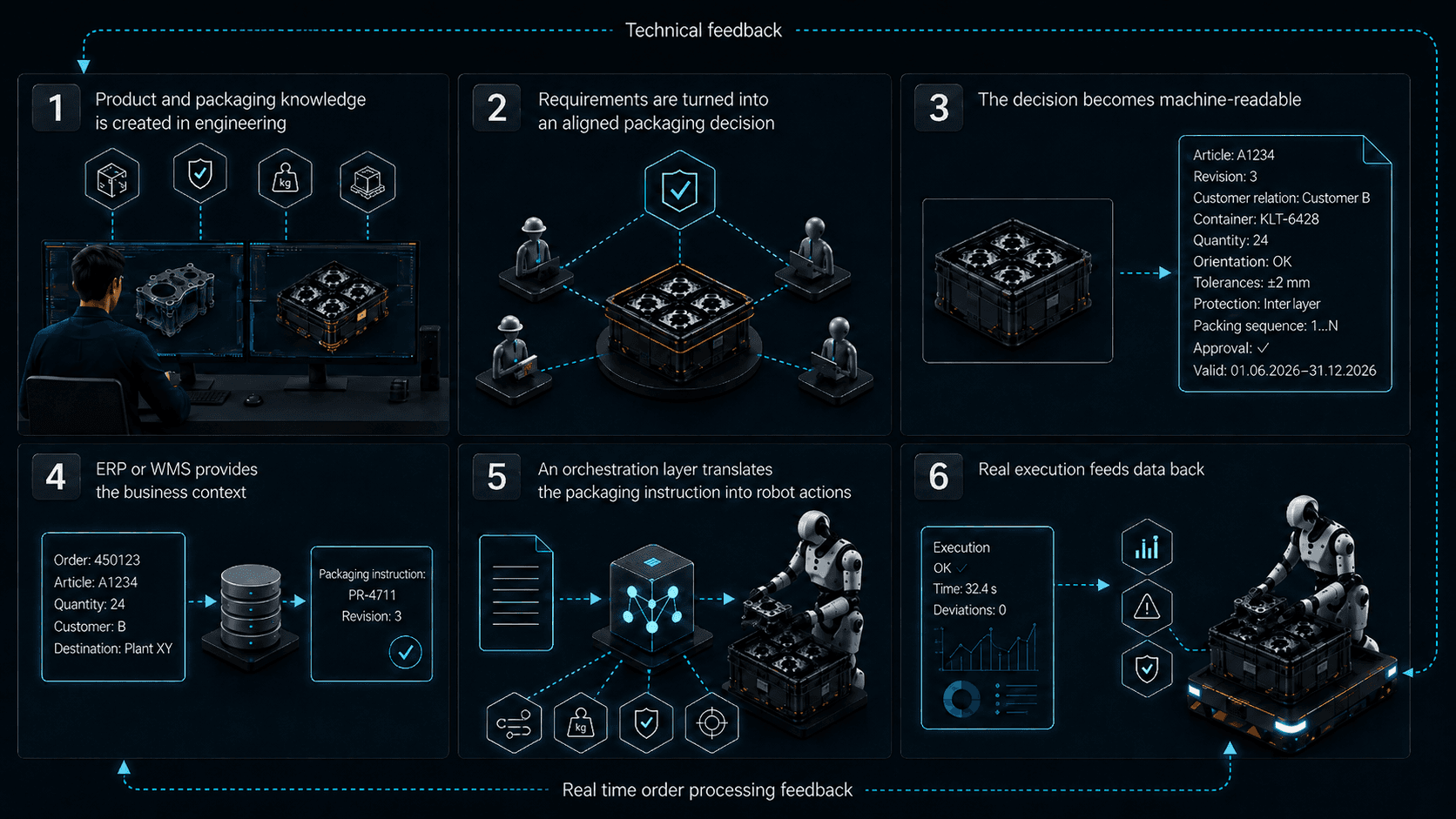
Figure 1: From engineering to robotic execution: A possible future data flow for autonomous packaging, including machine-readable packaging instructions, ERP/WMS integration and closed feedback loops.
What companies can already do today
No one needs to wait for the perfect humanoid robot for this development to take place.
The most important groundwork doesn’t concern robotics anyway, but rather data.
Companies can start today by
systematically documenting packaging requirements,
making different concepts quantitatively comparable,
clearly versioning and approving packaging decisions,
storing relevant product, container, packaging, and process information in a machine-readable format,
link packaging data to ERP, WMS, and other enterprise systems, and
systematically report back on actual execution.
The most suitable initial use case is not necessarily the most spectacular one.
A stable, regularly recurring packaging process with clearly defined items, load carriers, delivery routes, and customer requirements is often more valuable.
This is because it allows you to verify whether the data is actually complete enough so that not only a packaging planner but also, later on, a robot can unambiguously understand what needs to be done.
The new role of packaging optimization
In this vision, packaging optimization software takes on a significantly greater role than simply calculating packing density.
In the future, its role will lie between engineering and execution.
It can consolidate CAD data, product information, packaging materials, logistical requirements, handling limits, compliance, costs, and sustainability metrics.
It can calculate and compare variants in a matter of moments.
It can document decisions and support approval processes.
And it can generate structured data from the approved results that can later be reused by ERP systems, digital twins, AI agents, or robotics platforms.
This is precisely where Pakera comes in.
The goal is not to replace the robot’s intelligence.
On the contrary.
The more capable robots become, the less packaging software needs to dictate their movements.
However, this makes a reliable digital source for determining which packaging goal should be achieved in the first place all the more important.
The future of packaging logistics therefore does not begin with robots
The frequently asked question today is:
When will humanoid robots be able to take over tasks in logistics and production?
Perhaps another question is at least as important in the long term:
Are our processes and data even prepared to assign them clear tasks?
A human can often compensate for missing information through experience. They know the customer personally, remember the last packaging job, are familiar with the company’s available storage and transportation options, know the product and its specific protection requirements, can ask a colleague, or intuitively recognize that a solution won’t work.
An autonomous system requires this information explicitly, consistently, and at the right time.
This is precisely where one of the crucial next steps in industrial digitalization could lie.
Not in leaving every process entirely to the robot.
But in structuring knowledge in such a way that people, enterprise software, and machines can all understand the same approved decision and implement it together.
Then the key statement is no longer just:
“The robot can pack.”
But rather:
“The robot knows which packaging target has been approved for this supply chain—and can implement it autonomously, reproducibly, and traceably.”
And that is precisely where the next generation of industrial packaging planning begins.
See here how Pakera supports that development
Digital Pallet & Container Optimization
Packaging Report & Documentation
Sources:
International Federation of Robotics: “Humanoid Robots: Vision and Reality Paper Published by IFR,” August 14, 2025. https://ifr.org/ifr-press-releases/news/humanoid-robots-vision-and-reality-paper-published-by-ifr
GXO Logistics, Inc.: “GXO Signs Industry-First Multi-Year Agreement with Agility Robotics,” June 27, 2024. https://investors.gxo.com/news-releases/news-release-details/gxo-signs-industry-first-multi-year-agreement-agility-robotics
BMW Group: “BMW Group Advances the Use of Physical AI in Production with the Figure 03 Project in Spartanburg,” June 25, 2026. https://www.press.bmwgroup.com/global/article/detail/T0458778EN/bmw-group-advances-the-use-of-physical-ai-in-production-with-figure-03-project-in-spartanburg
OPC Foundation: “OPC UA for ISA-95 - Part 4: Job Control,” Version 2.0, date not specified. https://reference.opcfoundation.org/ISA95JOBCONTROL/v200/docs/1
OPC Foundation: “OPC UA for Robotics - Part 1: Vertical Integration,” Version 1.02, September 9, 2025. https://reference.opcfoundation.org/specs/OPC-40010-1/full
OPC Foundation: “OPC UA for PackML – Common Object Model: PackML,” Version 1.01, date not specified. https://reference.opcfoundation.org/specs/OPC-30050/1
GS1: “EPCIS Standard,” Version 2.0.1, June 2022. https://ref.gs1.org/standards/epcis/2.0.1/
GS1: “GS1 Logistic Label Guideline,” Release 1.3, August 2019. https://www.gs1.org/standards/gs1-logistic-label-guideline/1-3
FANUC America Corporation: “Picking & Packaging Robots,” date not specified. https://www.fanucamerica.com/applications/picking-packaging
Universal Robots A/S: “Robotic Packing,” date not specified. https://www.universal-robots.com/industries/logistics/robotic-packing/
European Commission: “Guidance document for Regulation (EU) 2025/40 on packaging and packaging waste,” June 10, 2026. https://eur-lex.europa.eu/legal-content/EN/TXT/?uri=OJ:C_202603084
Federal Institute for Occupational Safety and Health: “Manual Lifting, Holding, and Carrying of Loads,” continuously updated topic page. https://www.baua.de/DE/Themen/Arbeitsgestaltung/Gefaehrdungsbeurteilung/Handbuch-Gefaehrdungsbeurteilung/Expertenwissen/Physische-Belastung/Heben-Halten-Tragen/Heben-Halten-Tragen_dossier